👋 Welcome to Engdahl Motorsport webshop! 🏁
⚙️ We deliver tested ECU solutions and parts for serious builds
✈️ We ship most of the inventory internationally
⚙️ We deliver tested ECU solutions and parts for serious builds
✈️ We ship most of the inventory internationally
Follow us on social media 


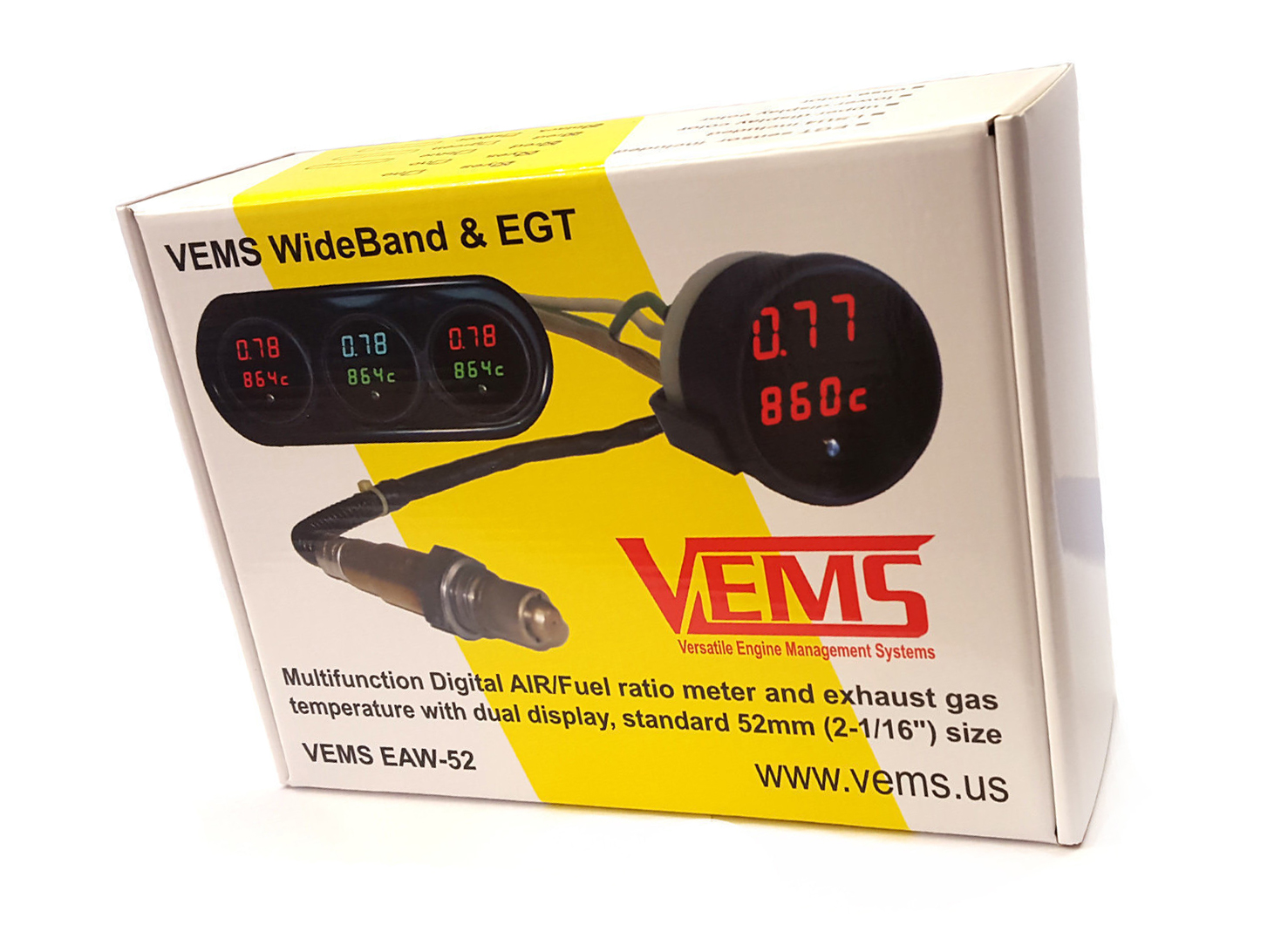
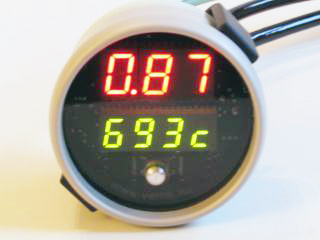
Broadband lambda + EGT meter VEMS RoundV2 with PWM outputs
€267.45
Note: The only colors currently available for this item are blue/blue!
Note: Shipped without a box.
It is VEMS itself that has changed the product, not us.
----
VEMS’s own multifunction broadband lambda and EGT meter, for those of you who run stock fuel injection or carburetors but want to monitor the lambda.
It comes with a Bosch LSU4.2 or LSU4.9, as desired.
Unlike other similar meters, this smart meter also features an RPM input and an analog input.
It also has 2 built-in PWM outputs, making it a highly capable boost controller!
Perfect for older cars lacking lambda and boost pressure control.
The gauge also has several different modes where it can display lambda, EGT, voltage, the analog signal (e.g., boost pressure), and even RPM! It can also be used to control, for example, an idle valve.
Of course, it’s also possible to output a 0–5-volt lambda signal to fuel injection systems that lack a lambda sensor, such as Nira, Megasquirt, Link, Vipec, etc.
Please specify if you’d like a color other than the standard red and green for the digits. (NOTE: 2-week delivery)
Available in the following colors:
Blue Blue
Note: Made-to-order item, 2-week delivery
- Secure payment by card
- E-mail us, we reply swiftly!
Description
Article no.: 209
V2 has 6 more status LEDs, more outputs and inputs than VEMS Round WBO2 EGT.
The several extra features of RoundV2 make it capable to concurrently handle multiple control-loops (besides the WBO2 related control loops: boostcontrol or simple idle-control or even producer-gas reactor temperature control, gas-engine fuel-mixture lambda-control or island -mode RPM control):
more analog inputs - useful for logging, or the control loops
3 power outputs with firmware support for (currently) 3 independent control loops (+WBO2 has additional power output and 2 control loops)
more flash space available for future firmware features
6 additional multicolor (red-green-yellow) status LEDs
Feedback signal for the 3 controllers can be:
analog input (eg. boost control or temperature control, nonlinear inputs configurable with custom curve)
wideband lambda value (mixture control eg. for wood-gas engines)
RPM (idle control)
EGT (K-thermocouple, eg. for gasifier bed-height control, output period up to 33 seconds suitable for auger-enable signal)
Custom PWM command signal possibly from serial port via AIM-compatible sender like the VEMS v3.x ECU - besides displaying values measured directly or received from the engine control unit (like MAP, lambda, RPM, EGT ...) RoundV2 can be used to drive additional 5A outputs (12-14V by default, and max 40V if related protection diode is moved from the DSUB15 to the external device). Useful if more (than the onboard 30+ outputs of VEMS v3.x) outputs are required for a high-end V8 or V12 application.
This is intended as an easy-to-use device, but quite a few advanced features are also supported.
WBO2. real WBO2 control circuit (full implementation), not a fake value from narrowband voltage as most ledbar displays
EGT (with cold-junction measurement)
onboard temp
dimming
display signal of RPM (frequency) input. Supports 0/5V HALL or optical sensor, or AC signal from variable reluctance (VR) sensor (1 bias resistor might be needed depending on the signal properties).
high visibility display of any data coming from RS232 (eg. from genboard v3 controller or other ECU via AIM protocol)
display the signal from 0-5V analog input with custom configurable curve
0-5V analog output. EGT signal, or WBO2 lambda/AFR signal with custom configurable curve (narrowband emulation also possible)
Data can be logged to PC for further analysis
The device can receive data via the RS232-DSUB9 port in "AIM" format, and display values with scaling (eg. from Celsius to Fahrenheit, km/h to mph conversion). See the product page below for how to set this up. Note that the cheaper Display-Only Round can also do this (that looks the same, but has only RS232 cable)
firmware upgrade via bootloader (from command line or from VemsTune
even bootloader upgrade is possible (for improved network support)
Boost control function is now supported (2010-04) at the same time as WBO2 and EGT (wastegate control via PWM-solenoid) (with RPM dependent target and reference-PWM values) .
Alternatively, instead of boost control, idle control or producer-gas mixture lambda control can be configured as well
Idlecontrol uses the RPM input for feedback and controls a PWM-solenoid valve to feed air to an engine
Producer gas mixture lambda control uses the wideband (LSU4 WBO2) sensor placed in the exhaust, and controls a 2-wire PWM idle-valve to feed air (usually there is a 1/2"-1" primary manual valve, and this smaller electric valve (eg. from a VW-passat gasoline engine) in parallel to it makes up for the variations (as the wood-gasifier internal conditions change over time, eg. temperature, moisture content, CO2 content). to eliminate most of the manual tweaking of the CHP (combined heat and power) powerplant otherwise requires to produce power/electricity (and heat), from woodchips or other suitable solid fuel of this device. If you need more outputs, or ignition control (and possibly injection for startup / backup / testing), check the v3.x controller also supports this, and much more (eg. stepper-based idle control that can support much bigger valves with lower valve-power consumption).
Files and media
 | Attached file |